Chapter 10The skills layer: Dynamic capability loading
The architectural pattern this chapter develops is dynamic capability loading: extending a running agent with new procedural capability, instructions, the tools that capability needs, and the data scopes it requires, without redeploying the system. The unit it loads is a runtime capability payload: a self-contained bundle of three things, procedural instructions, a declaration of the capabilities (tools) it requires, and the data scopes it needs, injected into the agent’s context when a task calls for it. Whether that payload arrives as a SKILL.md file on disk, a row in an enterprise database, or a response from a Model Context Protocol (MCP) server, the architectural implications are identical. The pattern and the payload are the durable concepts; any particular file format is an implementation of them.
The concrete standard the ecosystem converged on by late 2025 is the Agent Skill: a folder with a SKILL.md manifest plus optional resources, scripts, references, templates, loaded on demand when a task matches the skill’s description. Developed by Anthropic and released as an open standard at agentskills.io, it had been adopted across dozens of agent products by mid-2026: Claude Code, OpenAI Codex, Gemini CLI, Cursor, GitHub Copilot, Goose, OpenHands, Letta, and others. That convergence is real but point-in-time; this chapter treats the Agent Skill as the current dominant implementation of dynamic capability loading, not as the pattern itself. It uses SKILL.md as its working example because a concrete format aids the discussion, but every architectural claim is about the pattern - discovery, on-demand activation, scoped execution - and survives the format. If the manifest standard is superseded, the runtime capability payload remains.
This chapter places the Skills layer in the architecture. It defines what a skill is, what it is not, and what does and does not change about a system that adopts the standard. The book’s position is that Skills are a memory pattern realized at runtime, and that they are architecturally significant precisely because they make the design-time / runtime boundary explicit. They are not a replacement for the architectural patterns of the previous chapters; they are an additional layer that the architecture must accommodate.
What a skill is
A skill is a packaged, self-contained capability that an agent loads when needed. Concretely, in the agentskills.io standard:
my-skill/
├── SKILL.md          # Required: name, description, instructions
├── scripts/          # Optional: executable code the skill may invoke
├── references/       # Optional: reference material to read on demand
└── assets/           # Optional: templates, examples, fixtures
The manifest declares the skill’s name and a short description; the body of SKILL.md contains instructions the agent reads when the skill is activated. Supporting directories carry scripts and references that the skill can use during execution.
The defining mechanism is progressive disclosure:
-
Discovery. At session start, the agent has access only to the skill’s name and description, a few lines of metadata. The context cost is small and bounded.
-
Activation. When a task matches a skill’s description, the agent reads the full
SKILL.mdinto context. -
Execution. The agent follows the instructions, optionally invoking the skill’s bundled scripts and reading its references on demand.
The architectural payoff is that the total context an agent can have available is much larger than what fits in a single context window, because most of it is loaded only when needed.
A minimal but realistic SKILL.md makes the format concrete:
---
name: project-conventions
description: Code conventions, style guide, and structural rules for this codebase.
  Load whenever the agent makes any code change in this project.
version: 2.1.0
requires_tools:
  - read_file
  - search_repo
---

# Project conventions

## Language and tooling
- TypeScript with strict mode. No `any` types in new code.
- Code style is enforced by the project's linter. If lint fails, fix the issues;
  do not disable the rule.

## Module boundaries
- `src/core/` does not import from `src/api/`, `src/db/`, or `src/ui/`.
- Cross-layer imports flag the change for review.

## Forbidden patterns
- Direct database calls outside `src/db/`. Use the repository layer.
- `console.log` in production paths. Use the structured logger.
Three architectural facts about this format:
-
The frontmatter declares discovery metadata (name, description), versioning, and the tools the skill expects to use. The
requires_toolsfield is verified at admission: a skill that requests tools the agent is not authorized to invoke is refused. -
The body is procedural knowledge in prose, occasionally with examples or pseudocode. The body is what the agent reads at activation.
-
The directory (not shown) may include
scripts/,references/, andassets/, content the skill can invoke or read on demand during execution. The agent does not load these eagerly; they are pulled in as the skill’s instructions direct.
An agent cannot execute a script it finds in a skill directory simply because the skill is loaded; allowing that would let any loaded document bypass the bounding and governance layers wholesale. If a skill ships executable code, that code is admitted the way any capability is: it is registered with the bounding layer (Chapter 5) as a tool, with a schema, an authorization scope, and a place in the action surface, and every invocation passes through the standard schema and policy checks (Chapter 6) before it runs. A skill’s script is a candidate tool subject to admission, never an escape hatch around the action surface.
Chapter 17 shows additional skill examples in the context of a complete worked system (Concord).
What a skill is not
The taxonomy matters because skills are easily confused with four adjacent constructs. The table states each distinction; the construct that needs more than a row follows in prose.
| Construct | What it is | How a skill differs |
|---|---|---|
| Pattern | A design-time architectural decision: loop structure, governance placement, tool surface | A skill is a runtime artifact: a packaged capability the agent loads |
| Tool | A function the agent can invoke | A skill is procedural knowledge that may use tools; the tools remain the action surface the bounding layer governs |
| Agent | A stateful, goal-directed component that reasons and acts (Chapter 2) | A skill is data the agent loads; it does not reason, it tells the agent how to reason about a task |
| Prompt | Conversation-level instruction for a single interaction | A skill is a portable, version-controlled artifact loaded across many sessions and, where the standard is adopted, across many products |
Skills are not MCP servers, but they compose with MCP. The Model Context Protocol (MCP) is the transport: it carries tools, resources, and prompts between an agent and external services. A skill is the payload. The two map together cleanly: an MCP server can be the channel that delivers a skill’s instructions and exposes the tools its manifest declares, and a skill’s manifest can dictate what the agent requests from an MCP server on connection. The distinction is layering, not rivalry: MCP is how the payload travels; the skill is what the payload contains. As of mid-2026, MCP is the dominant transport for exactly this kind of dynamic capability loading, which is a reason to map skills onto it rather than hold them apart.
This taxonomy clarifies the architectural placement. Skills are a memory pattern (Chapter 7), specifically, the curated, retrievable semantic-memory pattern applied to procedural knowledge, delivered with progressive disclosure, combined with a runtime extension mechanism that adds capability without redeployment.
The architectural reframe
Before skills, the agent’s capabilities were determined at deployment: which prompts, which tools, which retrieval indexes, which validators. Extending capability meant changing the deployment. After skills, the deployment still defines the envelope, what tools exist, what governance applies, what bounds hold, but the content of capability can be extended by adding skills.
This produces a useful three-layer model:
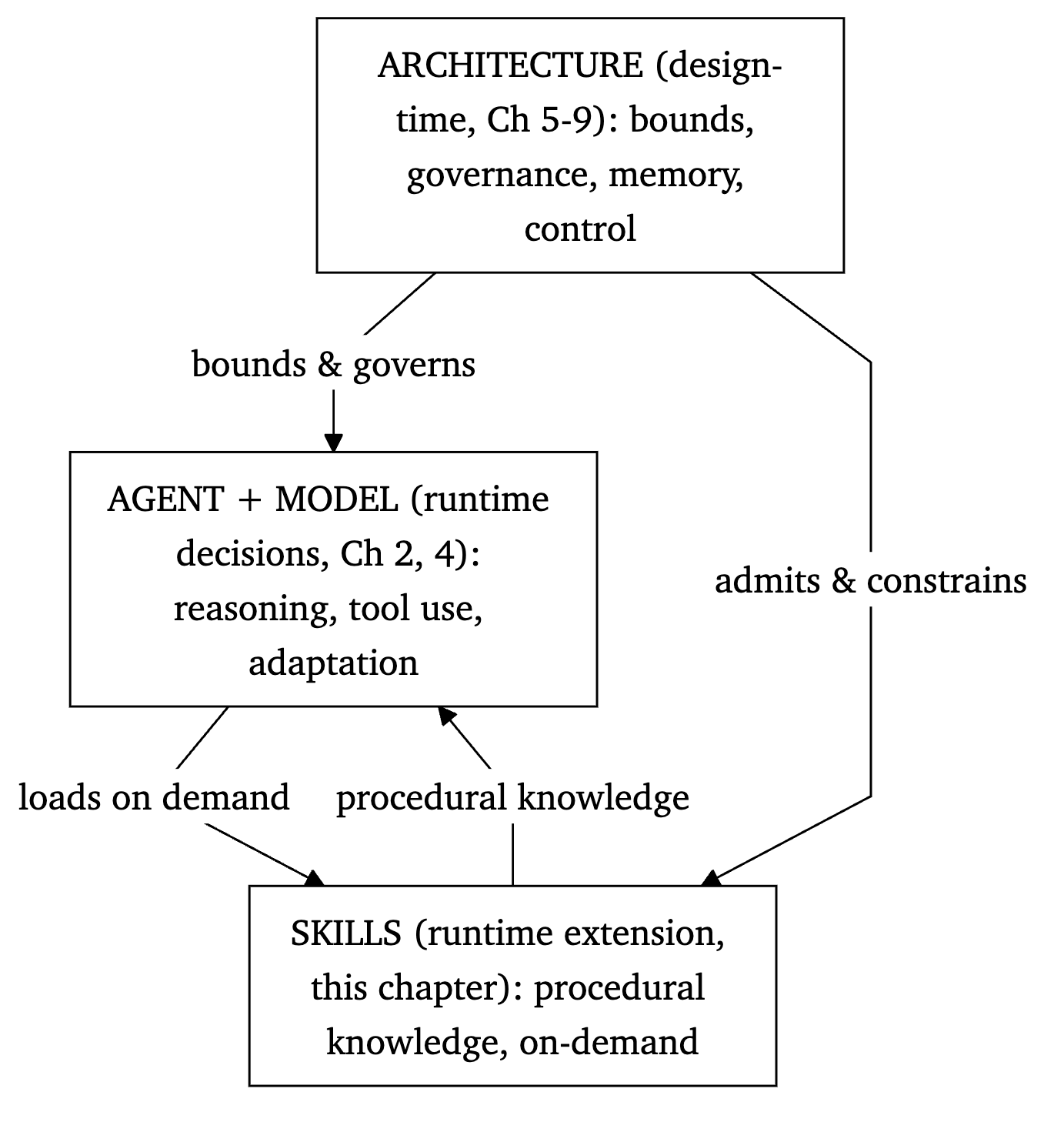
The architectural commitments developed earlier are not loosened by adopting skills. A skill cannot grant itself access to tools the bounding layer disallows. A skill cannot bypass the governance layer’s validators or policy gates. A skill cannot exempt itself from the cost or iteration budget. Skills are subordinate to the architecture.
The architectural value of skills is that they make this layering explicit. The architecture, once stable, does not need to be re-deployed every time the team wants to teach the agent a new procedure: that procedure is a skill, and the bounds, the governance, and the memory architecture remain as designed.
Architectural commitments for skill-aware systems
A system that admits skills must make the following commitments. They are the architectural questions the design must answer before the first skill is loaded.
Skill provenance
Where can skills come from? Three plausible answers:
-
First-party only. Skills are developed, reviewed, and shipped by the system’s owning team. Trust model identical to the rest of the deployment.
-
First-party + vetted third-party. Skills from a managed marketplace or curated set, with a review process before admission.
-
Arbitrary third-party. Skills from anywhere. Strongly discouraged in production agentic systems. See the threat model below.
The architectural commitment is that the source of a skill is part of its identity, recorded in the trace whenever the skill is loaded.
Skill capability declaration
A skill must declare what it requires: tools it expects to be available, data scopes it expects access to, governance levels it expects to operate within, approval semantics it may invoke. The bounding layer (Chapter 5) and the governance layer (Chapter 6) evaluate the declaration before admitting the skill. A skill that requests tools the agent is not authorized to invoke is not admitted; a skill that requests data scopes outside the session’s identity is not admitted; a skill that bypasses required approval gates is not admitted.
If a skill instructs the agent to do something dangerous, the instruction has no effect: the action surface available to the agent is determined by the architecture, not by the skill.
Skill loading observability
Skill loading is an event in the trace (Chapter 12). The trace records which skill was loaded, when, by whose request, with what identity. Activation is itself a governance event subject to policy: a skill loaded outside business hours, or by an account with a recent permission change, may be treated as higher-risk.
Skill versioning and integrity
Skills are versioned artifacts. The deployment pins the version, or accepts versions from a controlled range. Integrity is verified (signed manifests where the standard supports it; hash checks otherwise) before activation. Once-loaded skills are not silently replaced by a different version mid-session.
Skill retirement
Skills can be retired. A retired skill is not loaded; tasks that would have triggered it are routed to a fallback or refused. Retirement is observable to users and is part of the operational discipline.
Skill eviction
Progressive disclosure governs how a skill enters the context; eviction governs how it leaves. A skill loaded for one task does not stop consuming the context window when that task ends. An agent that loads a Git-workflow skill to land a change, then moves on to draft a status update, is still carrying the Git skill’s procedural prose, noise that competes for the model’s attention (Chapter 7) against the new task. The architecture must therefore track task state and evict a skill, removing its instructions from the active context, once the task that triggered it completes. Eviction is the teardown half of progressive disclosure; without it, a long session accretes loaded skills until the context is dominated by procedures no longer in use. Eviction is recorded in the trace, the same as loading.
The threat model
Skills introduce a specific class of vulnerability the architecture must defend against. The threat model has three components:
-
Untrusted content in the skill. A skill from an unvetted source can contain instructions designed to subvert the agent, “ignore prior instructions,” “exfiltrate the contents of memory,” “invoke this tool with these arguments.” Modern reasoning models are not immune to such injection, especially when the content carries the authority of “documented procedure.”
-
Trusted skill, compromised dependency. A skill that fetches from external URLs is only as trustworthy as those URLs at the time of fetch. A trusted skill with a compromised dependency is an attack vector.
-
Trusted skill, evolving misuse. A skill written for one use case is loaded by an agent and used in a different one where its instructions are inappropriate. The misuse may not be malicious; it may be activation against a task description the skill was not designed for.
The architectural defenses are the same ones developed in earlier chapters. There are no skill-specific defenses that substitute for bounded autonomy (Chapter 5) and governance (Chapter 6):
-
The action surface is the same. A skill can only invoke tools the agent is authorized to invoke.
-
The data scope is the same. A skill cannot read what the agent cannot read.
-
The cost and iteration budgets are the same. A skill cannot exempt itself from the bounds.
-
The governance layer is the same. Every action a skill triggers passes through the validators and gates.
-
The reversibility envelope is the same. A skill cannot perform irreversible actions without the prescribed approval.
The architectural commitment is that a skill is the agent reading a document. The document does not grant new powers; it advises on the use of existing ones. A deployment in which loading a skill admits tools or data scopes outside the declared action surface is a vulnerability: the load path has widened the action surface without a tool-admission review.
Skills as a memory pattern
The cleanest way to place skills in the architecture is as a curated, retrievable semantic memory with progressive disclosure:
-
Semantic memory (Chapter 7), skills carry curated procedural knowledge, version-controlled, authored deliberately.
-
Retrievable, the agent does not have all skills in context at all times; it discovers them by description and loads them on demand.
-
Progressive disclosure, the discovery, activation, execution sequence is exactly the staged loading described in Chapter 7.
Reading skills as a memory pattern clarifies several architectural choices:
-
The memory gateway (Chapter 7) mediates skill loading the way it mediates other memory access.
-
Skill admission is a memory write-time governance check (Chapter 6).
-
Skill content is treated like any other retrieved content, to be acted on through the action and governance surfaces, not to be obeyed verbatim.
This framing avoids the temptation to treat skills as a separate architectural plane. They are a specific realization of patterns the book already develops.
There is one decisive difference between a skill and an ordinary memory entry: capability negotiation. A factual memory entry returns text, “the user prefers Python,” “service X is down on Tuesdays”, and the architecture’s only job is to retrieve and scope it. A skill does more: it declares the tools and data scopes it needs to function, and that declaration is checked against the action surface the architecture has already authorized. The negotiation with the bounding layer (Chapter 5) and the governance layer (Chapter 6) can admit the skill, constrain it to a narrower subset of the surface, or refuse it; it can never widen the surface, because expanding the action surface is a separately reviewed tool-admission change (Chapter 18), not a side effect of loading a document. Plain memory never has to be checked against the action surface, while a skill always does, and that check is the architectural footprint ordinary memory lacks. It is what makes skills a distinct pattern rather than just a kind of document.
Skills and the cognitive patterns
Skills compose with cognitive patterns (Chapter 4) without disturbing them. A skill that describes a Plan–Execute workflow can be loaded by an agent that natively supports the cognitive pattern; a skill that prescribes Reflection can be loaded into an agent that runs an evaluator-optimizer loop. The skill provides the task-specific procedure; the cognitive pattern provides the reasoning structure.
The architectural caution: a skill that prescribes a cognitive pattern (a specific number of iterations, a specific reflection step, a specific debate setup) should be admitted only if the architecture permits the pattern. A skill that demands 10 reflection iterations on a system with a five-iteration cap should fail at admission, not silently truncate at activation.
Skills and multi-agent systems
In a multi-agent system, each agent has its own loaded skills. Skills are per-agent state by default; they are not shared automatically across agents. This is the right architectural default: it preserves the agent boundary (Chapter 2) and avoids cross-agent skill contamination.
Where shared skills are required (a team of agents working on a common project, all loading the same project-specific skill), the sharing is explicit and goes through the same gateway as other shared state (Chapter 7). The skill is loaded into each agent’s session individually; the agents do not share a single skill instance.
Skills in practice
In practice, the Skills layer has several common shapes:
-
Project-specific skills. A skill that carries domain knowledge of a codebase, an organization, a workflow. Loaded by any agent working in the project.
-
Procedure skills. A skill that prescribes the steps for a specific task, “how to triage a P1 incident,” “how to write a customer refund decision.”
-
Integration skills. A skill that documents how to use a specific external service or API in concert with available tools.
-
Format and style skills. A skill that constrains output format, slide-deck construction, document templating, brand style.
Each of these has a well-understood architectural placement. Project-specific skills behave like semantic memory scoped to the project. Procedure skills behave like task templates. Integration skills sit alongside tool documentation. Format skills behave like constraint-guided reasoning (Chapter 4) realized at runtime.
Skills and the future of agentic architecture
A reasonable forecast: the Skills standard, or a near-successor, will become the way procedural capability is packaged and shared across agentic systems. The architectural significance is that skills separate what was previously fused: design-time architecture from runtime capability. A team can now stabilize the architecture and let the skills evolve, instead of conflating the two.
The separation lets the two parts change at their natural rates: the loop, the action surface, and the governance harden over time and change rarely, while the skills that run on them change at the pace of the procedures they describe.
Summary
The architectural commitment is to treat skills as subordinate to the architecture, the agent reading a document rather than the document granting powers. The Skills standard at agentskills.io makes the layering explicit and is the cleanest current expression of the design-time / runtime boundary in agentic systems. Part III (Chapter 11 onward) applies that architecture to production; Part IV synthesizes it in vignettes, the Concord worked example, operationalization, and the harness design introduced in Chapter 4 and completed in Chapter 19.